Wednesday, January 18, 2017

Your Font Matters: a cartography workshop

This post is part of a series to augment The Worldbuilder's Handbook available for free download.

This and other world workshops are gathered in my Worldbuilding Directory for you to explore.

Find more map-making content in my Cartography Directory.


When mapping your world, a few factors impact the overall feel of your map. Visual cues communicate information about your world at a subliminal level, and your readers absorb this information within moments of glancing over your map for the first time. While your colors and mapping style create the general atmosphere for your map, your font is what really embodies the spirit of your world.

It can be tempting to pick ornate fonts with grand details, but fancy fonts rarely work for cartography labels. Ornate fonts are often obscured at smaller sizes, so your best bet is to select a simple font that's easy to read. A map can backfire when the font is too hard to decipher. If you have your heart set on a particular font that won't work for small labels, use it for the largest labels and pick a simpler font for the rest.


Check out The Worldbuilder's Handbook for more free resources!


In addition to simplicity, your font style needs to convey the spirit of your world. Curly fonts often seem cheerful and provide for an idyllic feel, whereas Gothic fonts can feel gloomy and impart a sense of danger or foreboding. Scripts that resemble handwriting elicit an older setting than modern fonts, which evoke a sense of technological advancement. To portray a medieval or ancient world, try fonts that appear to bleed into parchment or be carved into stone.

Combined with astute color selections and the style of your map, the font you select establishes certain expectations in your readers. With the free exclusive How to Make Fantasy Maps in Photoshop, you can decide upon the colors, styling, and font for your own maps. By choosing a legible font that captures your world, you can prime readers with the right expectations, so they can experience your work as you intended. A spot-on map will also draw the right interest, from people who will enjoy and share your work.


That's it for this post! Check out the latest worldbuilding workshops for more.

Download The Worldbuilder's Handbook here, or start your adventure below.


Liked this? Share, please!

Wednesday, January 11, 2017

A Worthy Re-Read: inspiration & spark

This post is part of a series to augment the Author's Manifesto available for free download.

This and other inspirations of mine are gathered in the Spark Directory for you to explore.

Find more prophetic poetry in my Portents Directory.


Some stories rely on plot twists to keep readers guessing, but there are better ways to create suspense. Instead of keeping you in the dark, dear readers, I encourage you to see the convergence. I want you to anticipate things happening in advance. My goal is to make the unfolding story so breathtaking that you have to read it anyway. It grips you. It sculpts your experience. It builds your anticipation, then not only sates it but goes beyond your expectations. You are wowed by the nature of the tale you were expecting all along.

That's what builds for you as you read. It is your expectations being right, but also delightfully surprising and satisfying, as the story unfolds. Once you decide how a story's going to turn out...don't you want to see if you are right? And don't you love it when you also discover thrilling and unexpected additions to the story's equation? I know I do. That's why I write, to create the story that brings you to fruition. Put the clues together! I tell you what's going to happen, but I tell you in a different place.


Check out this Author's Manifesto for more of my inspirations!


You're supposed to see it coming. You're supposed to think about how desperately close everybody is to their destiny, the chance meetings, the timely happenstance that brings the ship of destiny. That's what prophesy is all about, right? You see it coming, but you still can't stop it. But instead of boring you into a sense of predictability, it thrills you. You're excited for the convergence, and can't wait to see how it unfolds. I want you to literally get thrills as you read it. Everything you expect turns out so blissfully unexpected that you crave one more page, every time you try to put it down.

The whole point is to see it coming. My prophesies share the sense of what's going to happen, but without enough explanation for it to spoil the story ahead. And even if you happen to decode the prophetic riddles, the way I tell the story should be so good that the unfolding delights you anyway. I can write twenty riddles of what's coming next, confident that even if you figure them out (some are tough, I hope!) you'll still love reading the story.

Don't you think you deserve a book you can read again and again? I'm crafting my Tales of the Known World saga to account for multiple read-throughs, after you discover secrets hidden within the novels. I write my stories to be just as enthralling to re-read as they were the first time. I've designed the story to seem one way on the first read, and once you learn more of the secrets unveiled across many books, the story changes for you, and there is a newness to the old books again. I want your perspective to shift as you learn things. If the place from which you enjoy the tale is different, the tale itself will read differently.

I've crafted my story to grip you on the first read, but I've added clues that won't have meaning until you unveil connections in later chapters. I've included Easter eggs inside the books, trifling details the first time around that thrill you with a secret tip-of-the-hat when you re-read the novel. I want the layers of meaning to keep building, to keep enthralling you, rewarding you every time you decide to re-enjoy my books. To show my appreciation for your readership, especially for reading my stories more than once, I took great care in adding wonderful secrets for us to share.


That's it for this post! Check out my latest inspirations for more.

Download the Author's Manifesto here, or start your adventure below.


Liked this? Share, please!

Wednesday, January 4, 2017

Humble Beginnings: inspiration & spark

This post is Part 1 of a series to augment the Author's Manifesto available for free download.

This and other inspirations of mine are gathered in the Spark Directory for you to explore.

Find more prophetic poetry in my Portents Directory.


I wrote my first poem in 5th grade, an entire year before I wrote my first story. It rhymed, but I wasn't impressed with it. I felt it read like a kid wrote it! (Imagine that.) The poem was a homework assignment, and before I turned it in, I had very little sense of what the poem's message was.

But when my teacher encouraged me to put in an extra line at the end to make the message seem more finished, I was indignant. I didn't like that she was making me change my poem, even though the day before I'd judged the selfsame poem sub-par. This, I suppose, was my first brush with criticism, and with external editing. Since then, I've come to understand that indignation as the resentful smothering of creative expression, which I'm convinced all humans share to some extent.


Check out this Author's Manifesto for more of my inspirations!


I realized later that the whole poem celebrated the beauty in life, but the last two lines ended with a sort of haunting rejection of the human condition. Years passed, and the unaltered poem was selected for a Poetry.com anthology I never bought a copy of. Thus I became a published poet as a teen, albeit an unpaid one. Even as my rumpled feathers were soothed, I didn't understand why they'd selected my very first, sub-par poem over newer poems I liked better. My current guess is that I'd shifted into non-rhyming poetry, and it resonated with fewer people.

In retrospect, my 5th grade teacher might have felt unsettled by the poem's conflicting messages, and wanted to teach me to be more consistent. Or maybe she figured a child wouldn't intentionally assert what the poem asserted, and endeavored to help me make the message more positive. To be fair, I hadn't intentionally created a message at all, not that it stopped me from rejecting her critique. Whatever her motivation, she convinced me that I should tack on a final non-rhyming phrase to wrap up the poem's jarring end.

After reluctantly hand-scribing a few silly parting words onto the construction paper mounting this cloudy jewel of a poem, I shrugged it off. Apparently, poetry was not my strong suit. This conclusion didn't trouble me. I was ten, and had better things to occupy my time. Since this was well before my Tales of the Known World saga, I saved the poem out of some mystical sense of self-duty, the same way I imagine scrap-bookers feel compelled to preserve their memories. Then I tucked away my predilection for rhyme to go read and watch Ninja Turtles.


That's it for this post! Up Next: Developing notions of meter and rhyme...

Download the Author's Manifesto here, or start your adventure below.


Liked this? Share, please!

Sunday, January 1, 2017

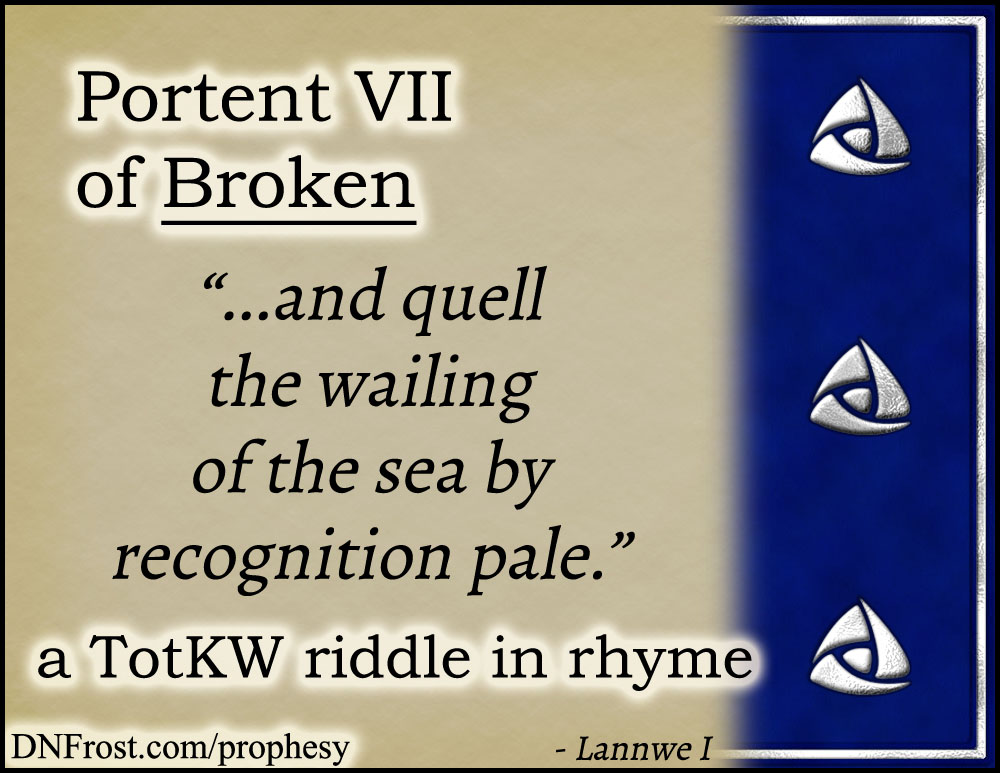
Portent VII of Broken: a riddle in rhyme

Portent VII of Broken: and quell the wailing of the sea www.DNFrost.com/prophesy #TotKW A riddle in rhyme by D.N.Frost @DNFrost13 Part of a series.
In the novel Broken, there are 24 portents fortelling the events of the unfolding saga.

Start with Portent I here.

These and other riddles in rhyme are gathered in the Portents Directory for you to explore.

Enjoy!


Farewell the bonds of timeless sight
Unlauded lowly left for right
To walk the earth they oust the night
And win the sunny vale

The timeless forced at last to see
For all that was now cannot be
And quell the wailing of the sea
By recognition pale.


Can you decode the future Tales of the Known World?

Share your interpretation!
Comment below with your take on this portent.


A pair of scenes early in Broken begin with quotes from this portent. Though short, this prophesy foretells the chilling end of an ancient civilization.

Who are the timeless forced at last to see, and what unlauded lowly do you think triggered their downfall?


Download the Prophesy Appendix:

The merfolk culture is built on the prophetic Gift. Nearly all men produce a portent every twenty days, and they devote their lives to interpretation. For more about the role and inner workings of prophesy, check out the Prophesy Appendix above.


Alongside every prophesy is an attribution block. This block contains a byline giving the name of the person who said the prophesy, and a dateline giving the day the prophesy was first said. Here is the attribution for this portent:
Dynvyi Lannwe Kaedya I
2:3:1:1/5, III:IX
The portent attributed here has not yet been interpreted. It was said recently, and it will be repeated every twenty days until either it is correctly interpreted, or it comes to pass.


That's it for this post! Up Next: From ashes cold flames overdue...

For the Prophesy Appendix, enter your email above.


Liked this? Share, please!

Wednesday, December 14, 2016

Why I Love World-Building: inspiration & spark

This post is part of a series to augment the Author's Manifesto available for free download.

This and other inspirations of mine are gathered in the Spark Directory for you to explore.

Find more worldbuilding content in my Codex Directory.


I love the world-building process. I love inventing something complex and rife with human disparity. I believe people deserve a well-crafted story and a well-defined setting for that story to unfold. But I also want to contribute to the entertainment paradigm. I believe the world needs more good stories, and I want my stories to matter.

The world I've built allows me great freedom for storytelling. I explore different social structures and cultural models, experimenting with the human condition and examining how any society's practices influence its people. I question normativity, because every culture has its own normal. I experiment with different definitions of normal, and I probe how individuals resist the pressures of society.


Check out this Author's Manifesto for more of my inspirations!


I also want the magic of my world to help readers understand the unity of nature, by showing the world from a more spiritual perspective. My readers relate to characters who live in a different paradigm, and they can resonate with the real spiritual maxims within that framework. By presenting this framework in a fictional setting, I provide a comfortable and safe venue for my readers to explore these spiritual truths without triggering people's real-world reservations about new ideas.

I love what I do. I must love what I do, because it can be long, lonely work. In many ways, writing a novel means surrendering the outside world to develop an inner world. Perhaps not all storytellers have found sanctity in their work, but when I weave my Tales of the Known World saga, I can tell that this is my calling.


That's it for this post! Check out my latest inspirations for more.

Download the Author's Manifesto here, or start your adventure below.


Liked this? Share, please!

Thursday, December 1, 2016

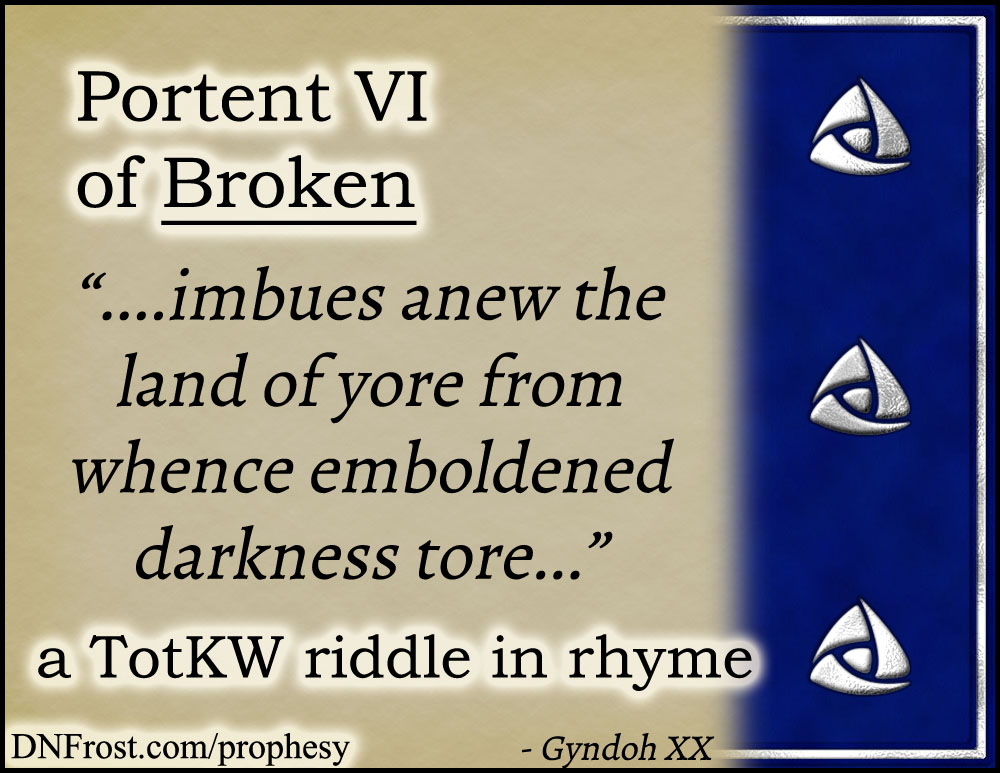
Portent VI of Broken: a riddle in rhyme

Portent VI of Broken: imbues anew the land of yore www.DNFrost.com/prophesy #TotKW A riddle in rhyme by D.N.Frost @DNFrost13 Part of a series.
In the novel Broken, there are 24 portents fortelling the events of the unfolding saga.

Start with Portent I here.

These and other riddles in rhyme are gathered in the Portents Directory for you to explore.

Enjoy!


Unearthing truth in timeless strands
The bleeding gate aware
Fulfills untiring fate's demands
To harness Hells with seeping hands
Of innocent in prayer

Departed now for distant shore
Relinquished friendless rose
Imbues anew the land of yore
From whence emboldened darkness tore
To seed a tide of woes

When slain embarks for Mother's womb
Displaced the vanquished quail
Amass for gate to reentomb
Their weary ranks and reassume
Their deaths to no avail

Triumphant rose in wake of peace
Redeemed with restless friend
Would dearest dreams at last release
For west and ancient battle cease
With days that have no end.


Can you decode the future Tales of the Known World?

Share your interpretation!
Comment below with your take on this portent.


A quote from this prophesy opens the first scene of Broken. I love the five-line stanzas and interesting rhyming pattern.

The portent itself foretells the ending of Book 4 in the TotKW Saga. Who do you think is the slain that embarks for Mother's womb?


Download the Prophesy Appendix:

The merfolk culture is built on the prophetic Gift. Nearly all men produce a portent every twenty days, and they devote their lives to interpretation. For more about the role and inner workings of prophesy, check out the Prophesy Appendix above.


Alongside every prophesy is an attribution block. This block contains a byline giving the name of the person who said the prophesy, and a dateline giving the day the prophesy was first said. Here is the attribution for this portent:
Nilwn Gyndoh Dynde XX
2:2:4:7/5, III:IX
The portent attributed here has not yet been interpreted. It was said recently, and it will be repeated every twenty days until either it is correctly interpreted, or it comes to pass.


That's it for this post! Up Next: And quell the wailing of the sea...

For the Prophesy Appendix, enter your email above.


Liked this? Share, please!

Wednesday, November 30, 2016

Fantasy Cartography with Butch Curry: an inspirational resource

This post is part of a series to augment the Guest Resources available for free download.

This and other guest-inspired content is gathered in my Guest Directory for you to explore.

Find more world workshops in my Worldbuilding Directory.


I first encountered Butch Curry's YouTube tutorials when working on an online role-playing game with a few friends of mine. I had no deftness in Photoshop then, so a more skilled friend searched for some tutorials on how to make digital fantasy maps. She discovered this wonderful series of video podcasts titled Fantasy Cartography with Adobe Photoshop. I watched a few tutorials to learn what sort of map was possible, and my friend started making the maps for our game.

Much later, when I started revamping the first manuscript for my Tales of the Known World saga, I recalled those tutorials and the pretty maps my friend created. I grabbed a notebook and set to work taking notes on the tutorials, everything from specific commands and settings to Butch's broader ideas about cartography theory.


Check out these Guest Resources for more inspirational content!


In his video podcast, Butch demonstrates step-by-step how to pull up different filters, create certain layer types, and execute a variety of useful commands in Photoshop. He also introduces a helpful Photoshop philosophy.

Butch focuses on using flexible tools that maintain independence from other design elements. This allows future changes without a great amount of effort. Whether you're new to Photoshop or just new to digital cartography, Butch Curry's Fantasy Cartography with Adobe Photoshop is a valuable resource I am proud to recommend.


And be sure to subscribe to Butch's awesome channel, if you haven't already!


That's it for this post! Check out the latest guest-inspired content for more.

Download the Guest Resources here, or start your adventure below.


Liked this? Share, please!

Friday, November 18, 2016

Styling the Cartography of Awakening: a mapping resource

This post is Part 2 of a series to augment the Codex of the Known World available for free download. Start with Part 1 here.

This and other mapping resources are gathered in my Cartography Directory for you to explore.

Find my maps and atlas content in the Map Directory.


After planning out the maps for my first book in Part 1 of this series, I chose an old-world style of mapping that resembles antique watercolor. However, this style uses topography symbols for mountains and forests, and I had to plan for the limitations of this cartography style.

On my maps, all mountain symbols are the same size, no matter the variations in altitude. In addition, the mountain symbols are roughly the same size as the treetop symbols for my forested areas. But I decided my audience would still read the landscape correctly, despite how the style compromised the literal accuracy of the maps.

However, my mapping style is also ill-suited to showing transitions. A topography symbol is either present or absent, whereas real land can transition gradually over huge areas. In order to define the topography borders in my maps, I had to decide what thresholds the land must reach in order to be marked with a symbol.


Check out the Codex of the Known World for more resources!


For my forests, I marked dense vegetation but did not mark the scraggly areas where trees give way to open sky. For my mountain symbols, I chose to mark all areas of stony elevation. Then I used small mountain peaks to denote lower-lying stony areas. By deciding these thresholds ahead of time, I stayed consistent throughout my whole atlas.

My cartography style uses more symbols to depict towns and landmarks, none of which can be drawn to scale. These discrepancies cause exact placement to be vague, especially when I map a zoomed-in portion of a previous map. For the first book in my Tales of the Known World saga, I decided to use the base of each symbol for vertical placement, and to center each symbol horizontally.

By considering the inaccuracies of my mapping style, I achieved a map aesthetic that captures the spirit of the Known World. I defined the symbols I planned to use and guidelines about their placement, representing my world without falling prey to inconsistencies between maps.


That's it for this post! Up Next: The apprentice cartographer's story...

Download the Codex of the Known World here, or start your adventure below.


Liked this? Share, please!

Wednesday, November 16, 2016

Plan Your Rivers: a cartography workshop

This post is Part 1 of a series to augment The Worldbuilder's Handbook available for free download.

This and other world workshops are gathered in my Worldbuilding Directory for you to explore.

Find more map-making content in my Cartography Directory.


As a worldbuilder, you have ultimate control over how your rivers flow, where your towns spring up, and the way your roads connect. But to create a realistic world that immerses readers in your story, you must consider some basic concepts about how lands form and civilizations rise. This implicit dynamic between rivers, towns, and roads will either lend credibility to your world or detract from the story at hand.

Rivers form when a region of land sheds water. Instead of fully absorbing into the soil, the water flows across the land, following the pull of gravity from highlands into lowlands. Small rivers tend to feed into larger rivers, and rivers tend to widen and slow down as the land flattens. A river basin or river valley is the depression in the land that guides the water downhill and to the coast. These basins are ringed with comparatively higher elevations, which channel the draining water into each basin.


Check out The Worldbuilder's Handbook for more free resources!


To plan your river, decide on the general type of rock or soil in a given basin, and then think about how much rainfall or meltwater that basin might shed in an average year. If that amount of water feels large enough to represent on your map, draw it in an appropriate width for its volume and speed. Add lakes or floodplains in the pockets of low elevation along your river, if they seem large enough to represent at scale.

Floodplains form when the volume of draining water increases suddenly, often due to a rainy season or spring thaw. The water level of the river rises, flooding its banks and picking up extra soil and other debris. Steep banks can constrain the rising waters, but riverbanks with gentle slopes allow the water to spread out. This slows the river's overall speed, and its fertile sediment settles over the flooded land. After the extra water drains into the sea, the floodwaters recede and the sodden floodplain is revealed.

To finish your river, assess how freshwater meets saltwater at the river's mouth. The elevation of land here impacts the way your river spills into the ocean and dumps the remaining sediment it has collected on its path. With the free exclusive How to Make Fantasy Maps in Photoshop, you can account for this sediment in the shallows and vegetation of each river's mouth.

Flat plains often host wetlands and river deltas, where the slow-moving sediment collects near the shoreline and builds up into islands or brackish swamps. Sandy beaches tend to be somewhat steeper and have thinner river mouths, increasing the river's speed. This can deliver sediment further out to sea, creating wide shallows or sandbars. Rocky bluffs often produce waterfalls or deep gorges, where fallen stones jut from the seas and the sediment is churned out into the depths.


That's it for this post! Up Next: How civilizations arise along rivers...

Download The Worldbuilder's Handbook here, or start your adventure below.


Liked this? Share, please!

Friday, November 11, 2016

Planning the Cartography of Awakening: a mapping resource

This post is Part 1 of a series to augment the Codex of the Known World available for free download.

This and other mapping resources are gathered in my Cartography Directory for you to explore.

Find my maps and atlas content in the Map Directory.


Before I could make any maps of the Known World, I had to decide what to show and what to omit from each map. I took some time to reflect on each map's audience, the best boundaries for each map, and the best dimensions to depict those boundaries. This gave me a basic level of detail possible for each map scale.

1) Map Audience: My maps are mostly for readers and fans, but also for me to print at home and use for reference. Instead of revealing my entire world to readers, I decided to only depict the area of the world known to the characters in my first book. Still a large area, the Known World refers to the lands united by the Katei Ocean, but it does not depict the Unknown East.

2) Boundaries: My first map depicts the full Known World, and subsequent maps show more detailed close-ups. For each map, I chose to represent a single region or cohesive area, with map boundaries no less than a half-inch from the edges of the region. With those dimensions set, I centered each region on the page, allowing for slight adjustments to omit distant islands or include important towns.


Check out the Codex of the Known World for more resources!


3) Dimensions: The Known World is wider than it is tall, so I chose a landscape orientation. To optimize the print-at-home dimensions of letter-sized paper, I decided to make all my maps 8.5" x 11". Print-quality resolution is 300 dpi (dots per inch), so I made my Photoshop documents 3300 x 2550 pixels. Coupled with my chosen map boundaries, these dimensions established a scale for each map.

4) Detail: The Known World map can only hold so much detail, because text labels blur at smaller sizes. In order to shrink my finished maps for online display, I realized I needed to leave some wiggle room to maintain legibility. With some baselines established, I decided to streamline the text in my world map and emphasize important details in my subsequent maps.


Since I wanted to make more than one map, I also had to make some decisions about the overall body of maps. To ensure a sense of continuity between maps, I needed to know how the maps would relate to each other. For cohesion with the plot of my book, I wanted to plan where each map would best fit into the story. And I had to consider how I'd present the finished maps in my Tales of the Known World saga.

5) Map Relations: Most of my maps depict the modern Known World as known to the people who live there. The sole exception depicts a lost land of the ancient world, as that land is known to the people in the modern world. I decided to make each map with identical Photoshop techniques, and to only use techniques that looked possible for a map-maker within the Known World.

6) Fitting the Story: Each book, section, and chapter receives a map as part of my writing process. A book's main map depicts the whole Known World, while each of the book's four section maps depicts an area conceptually or contextually relevant to the upcoming story arc. For each chapter, I also map a new region in which a scene from that chapter takes place. These thematic guidelines ensured my maps felt relevant throughout the storyline.

7) Presentation: Each map appears on the left side of a two-page spread in my book, with north aligned to the left edge and relevant text on the right side. The Known World map faces my table of contents, and each section map faces prophetic text heralding the events about to unfold. Chapter maps face the opening text of each chapter. For variety and ease of reading, I decided to make all chapter maps in portrait orientation, with north along the top edge.


That's it for this post! Up Next: How I picked the mapping style for Book 1...

Download the Codex of the Known World here, or start your adventure below.


Liked this? Share, please!

Wednesday, November 9, 2016

The Worldbuilder's Handbook: a workshop directory

This post is part of a series to augment The Worldbuilder's Handbook available for free download.

This and other world workshops are gathered in my Worldbuilding Directory for you to explore.

Find more content navigation in my Resource Directory.


Hello, there! Thanks for your interest in my worldbuilding techniques. My name is D.N.Frost, and I'm a fantasy author, fictional cartographer, and extensive worldbuilder. After designing myriad cultures, constructing multiple languages, and producing numerous maps for my Tales of the Known World saga, I've developed a realistic approach to building a complex world.

How exactly do you build a fictional world? I realized that a world's cultures, languages, and geography are connected, and that they influence each other through the course of history. To build more realism into your invented worlds, please enjoy this collection of short worldbuilding tips and workshops from TotKW Books.


Download your workshop guide The Worldbuilder's Handbook here.


These are workshops on worldbuilding and supporting examples from the TotKW universe. This nuanced approach to realistic worlds will help you build and share your world with more confidence. Your handbook will guide you through important facets of worldbuilding, from creating your first map to finding inspiration for new place-names.

This resource directory also links to a number of worldbuilding resources and longer blog posts, so you can delve deep into your favorite concepts. I'm proud to offer you this compilation of tips for worldbuilders, and I hope you use this resource to enhance your world.


That's it for this post! Check out the latest worldbuilding workshops for more.

Download The Worldbuilder's Handbook here, or start your adventure below.


Liked this? Share, please!

Wednesday, November 2, 2016

World of the Marshlanders: a map commission

This post is Part 1 of a series to augment the Fictional Cartography by D.N.Frost available for free download.

This and other map commissions are gathered in my Portfolio Directory for you to explore.

This post is also Part 1 of a series about Annis Pratt.


I first encountered professor-gone-author Annis Pratt when a previous map client recommended my services for Annis's series of published novels. Annis writes eco-fiction, promoting a sustainable and ecologically-friendly paradigm through the adventures of the Marshlanders in her invented world.

I said hello and clicked eagerly around her website, absorbing a cool sense of the world Annis had created. Then I invited her to connect with me for a map estimate when the time was right.


Check out this Fictional Cartography by D.N.Frost for more maps!


After a few months, Annis was ready to tackle her map, and I was thrilled when she contacted me to get started.

Annis provided me with a few pencil sketches of her world, and I started on a commission estimate for the entire map.

We discussed her map needs and budget to finalize our map plan, and I created her initial render.

I sent the mock-up to Annis for consideration, and she decided to commission the project.


Here's what she had to say about the finished map:


World of the Marshlanders, a map commission by D.N.Frost for Annis Pratt www.DNFrost.com/portfolio Part 1 of a series.
Bravo! It looks terrific.

I sense you have put extra work into this marvelous map.

I am impressed with your business procedures and art work.

I appreciate your thoroughness.

This is going to work well with a submission I'm just doing.

Thanks for everything. Terrific!

– Annis Pratt, eco-fiction author


That's it for this post! Up Next: Laying out tons of topography... Soon.

Want to bring your own world to life? We can map your world.
You deserve a professional map you can be proud to share.

Download Fictional Cartography by D.N.Frost here, or start your adventure below.


Liked this? Share, please!
Tuesday, November 1, 2016

Portent V of Broken: a riddle in rhyme

Portent V of Broken: the prince is born on builder's reef www.DNFrost.com/prophesy #TotKW A riddle in rhyme by D.N.Frost @DNFrost13 Part of a series.
In the novel Broken, there are 24 portents fortelling the events of the unfolding saga.

Start with Portent I here.

These and other riddles in rhyme are gathered in the Portents Directory for you to explore.

Enjoy!


The prince is born on builder's reef
To father's word and mother's grief
In duty shunted to the shore
To sighted land for coming war (I)

His advent clears the palace house
Who dynasty and truth espouse
While prophesy of import lost
Defies the dead at deadly cost

Across the waves the daemons sail
Beneath the waves a bloody trail
As rushes prince to father's side
To sacred truth of time abide. (II)


Can you decode the future Tales of the Known World?

Share your interpretation!
Comment below with your take on this portent.


This prophesy was said 32 years before Broken takes place, and it is referenced within the story as Tirrok explores the circumstances of his birth on his quest to the world of the merfolk.

Where is the builder's reef, and what prophesy of import lost do you think this portent heralds?


Download the Prophesy Appendix:

The merfolk culture is built on the prophetic Gift. Nearly all men produce a portent every twenty days, and they devote their lives to interpretation. For more about the role and inner workings of prophesy, check out the Prophesy Appendix above.


Alongside every prophesy is an attribution block. This block contains a byline giving the name of the person who said the prophesy, and a dateline giving the day the prophesy was first said. Here is the attribution for this portent:
Gynlen Njyae Dynde VI
1:2:3:4/13, 7:3:2 IX
V:I 2:1:2:2/11, 8:1:2
V:II 3:1:4:6/5, III:IX
The portent attributed here references multiple events that come to pass in sections called tatters. An additional tatter dateline has been added to the attribution for each tatter, noting the date when that segment of the portent will come to pass.


That's it for this post! Up Next: Imbues anew the land of yore...

For the Prophesy Appendix, enter your email above.


Liked this? Share, please!
Hello, there! Connect with me:
TwitterFacebookPinterestInstagram

Leave a comment, ask a question, share a story, make a friend.