Showing posts with label prophesy. Show all posts

Monday, February 7, 2022

A Note on Unpassed Prophesy: a prophetic resource

This post is Part 3 of a series to augment the Codex of the Known World available for free download. Start with Part 1 here.

This and other worldbuilding resources are gathered in my Codex Directory for you to explore.

Find more prophetic poetry in my Portents Directory.


In Part 1 of this series, I discuss the cultural reasons why I always use an /s/ to spell the word prophesy. The elusive merfolk publish their prophetic verses into books of epic poetry, known as story books.

The story book Portents of Mother's Gate should be considered a contemporary publication of the merfolk, released after the events of Book 2 in the saga, but prior to the events of Book 3. Therefore, the portents sequenced early in the story book have already reached fruition, and their events have already occurred.

Conversely, the portents listed later in the story book have not yet come to pass, and foretold events coincide with novels that have not yet been published in the Tales of the Known World saga. While these portents are certainly riddles, they do by nature contain spoilers. You have been warned.


Check out the Codex of the Known World for more resources!


For the prophetic merfolk, portents that have not yet come to pass are considered unpassed prophesy. While they have been tattered and interpreted, the events they predict have not yet occurred.

However, unpassed prophesy is still fully understood, and in many cases, scholars have determined the precise dates these events will come to pass. But these future dates are traditionally withheld from the public, to protect the sanctity of the timeflow.

In prior eras, the merfolk discovered that sharing the precise dates of future events tempted certain people to try to change those events. All of these attempts have been unsuccessful, and ironically many of them were crucial to the actual fruition of the events they were trying to subvert.

Regardless, scholars now avoid the entire issue by simply withholding the exact dates of unpassed prophesy from their story books. Within a story book, these portents are still arranged in correct story order, using the precise dates that scholars have deduced after their intensive process of tattering and analysis.

But instead of providing an exact date for each tatter’s fruition, the annotation VA is used. This VA note is read Vyanni Ari, short for vyehvyannilu songyoari, which means Approximate Day of Seeing.

For a thorough explanation of prophesy dates and approximations, see Appendix IV in the Prophesy Appendix below.


Download the Prophesy Appendix:

The merfolk culture is built on the prophetic Gift. Nearly all men produce a portent every twenty days, and they devote their lives to interpretation. For more about the role and inner workings of prophesy, check out the Prophesy Appendix above.


The use of VA is very common when tattering prophesy, especially in the early stages when interpreters are focused on dividing their latest portents, called raw prophesy, into disparate tatters.

Once divided, these tatters are then sequenced relative to each other, and the open-ended VA annotations are assigned approximate dates, which are adjusted as interpretation ensues.

When interpretation is completed, the approximated fruition date is converted into a verified dateline, and the tatter’s position in correct story order is finalized.

Portents then graduate from raw prophesy to unpassed prophesy. They are considered ready to publish into a story book, though their official dates are withheld from publication.

For a thorough explanation of prophesy tattering and annotation, see Appendix V in the Prophesy Appendix above.


That's it for this post! Check out the latest prophesy resources for more.

For the Prophesy Appendix, enter your email above.


Liked this? Share, please!

Monday, January 24, 2022

A Note on Prophetic Poetry: a prophesy resource

This post is Part 2 of a series to augment the Codex of the Known World available for free download. Start with Part 1 here.

This and other worldbuilding resources are gathered in my Codex Directory for you to explore.

Find more prophetic poetry in my Portents Directory.


In Part 1 of this series, I discuss the cultural reasons why I always use an /s/ to spell the word prophesy. The elusive merfolk are gifted with the ability to prophesy, and the poetry quoted throughout the saga is just a small sampling of their latest portents.

These prophesies of the merfolk predict events from the Tales of the Known World saga, some of which have come to pass in published books, and others which will come to pass in future books. When sequenced by the date at which they come to pass, these portents reveal the unfolding events of the saga, well in advance of the novels themselves. They are poems that tell the story.

But the prophesies are also riddles. Each portent is a single piece of an ongoing puzzle, and the pieces must be interpreted in order to determine the events that they predict.


Check out the Codex of the Known World for more resources!


Due to the volume of prophesy that is recorded every day, events in some portents inevitably overlap with events from other portents. This phenomenon is called the tattering, and interpreters study these overlaps to infer an unbroken stream of future events. Countless scholars have devoted their lives to the tattering of prophesy, which spans generations.

Prior to this tattering, prophesies must be indexed by the date on which they were said, as opposed to the dates at which the portents come to pass. This is the only way to keep uninterpreted prophesy organized. In this Portents Directory, you can browse the untattered prophesies from each published novel. Try your hand at interpreting them yourself!

After prophesy is tattered, the dates of future events can be deduced and used to arrange each portent into correct story order. The merfolk then publish anthologies of tattered prophesy into story books for public consumption. Check out the story book companion to the saga, Portents of Mother's Gate.

These story books are considered the epic poetry of the merfolk, and oral readings are a popular pastime. These readings are often paired with musical accompaniment, and sometimes visuals produced by light magic.


Download the Prophesy Appendix:

The merfolk culture is built on the prophetic Gift. Nearly all men produce a portent every twenty days, and they devote their lives to interpretation. For more about the role and inner workings of prophesy, check out the Prophesy Appendix above.


However, the tattering of prophesy can make it difficult to sequence full prophesies chronologically, since certain sections may come to pass at different times. In these instances, a prophesy is annotated into its disparate sections, called tatters, so the prophesy can be sequenced in multiple locations.

The tatter of chronological significance is further annotated with the date it comes to pass, which cues readers to sequence only the events of that particular tatter in story book order. For a thorough explanation of prophesy tattering and annotation, see the Prophesy Appendix available above.

This free download details the jargon and terminology that relates to prophesy, and it explains the meaning of the strange dates that accompany each quote. It also further explains how the tattering of prophesy works, as well as the prophetic cycle itself, and the cultural impact of prophesy on the merfolk and the Known World at large.


That's it for this post! Up Next: Withholding the dates of future events...

For the Prophesy Appendix, enter your email above.


Liked this? Share, please!

Wednesday, January 5, 2022

A Note on the Uncommon Spelling of Prophesy: a language resource

This post is Part 3 of a series to augment the Codex of the Known World available for free download. Start with Part 1 here.

This and other linguistic resources are gathered in my Language Directory for you to explore.

This post is also Part 1 of a series about prophesy. Find more prophetic content in my Codex Directory.


In Part 1 of this series, I outlined the many dialects and languages in my epic fantasy saga. Throughout the Tales of the Known World saga, the word prophesy is spelled with an /s/ in all cases. This is in contrast to the standard American spelling, which uses the /s/ form for the verb to prophesy and commonly uses the /c/ form for the noun a prophecy.

The reasoning for this spelling decision is threefold. Firstly, in many American-English dictionaries, including Merriam-Webster, the entry for the noun prophecy lists the spelling prophesy as an acceptable variant. It is therefore uncommon – but not incorrect – to use the /s/ form prophesy as a noun.

Moreover, Merriam-Webster lists two acceptable plurals for the noun prophecy, one as prophecies and the other as prophesies, further solidifying this /s/ form as being unusual but not ungrammatical.


Check out the Codex of the Known World for more resources!


Many languages around the world have different spellings for correlated verbs and nouns, as in the case of the American spelling of to prophesy and a prophecy. In the Known World, the language of the prophetic merfolk, commonly called Meri, is one such language.

In Meri, most verb/noun correlations, such as to swim and a swim, or to laugh and a laugh, are created with special adjustments that convert a root verb into its correlated noun. To illustrate this in English, consider how to speak becomes a speech, or how to meet becomes a meeting.

Meri is a very regular language, and exceptions to its rules and guidelines are rare. By all logic, the merfolk language should have a spelling differentiation between to prophesy and a prophecy. However, this word is one of Meri’s rare exceptions.

As opposed to a regular Meri pairing like speak/speech or meet/meeting, a highly irregular pairing uses the exact same word for both the verb and the noun form of prophesy.

This brings us to the second reason for using the /s/ form of the English word prophesy in all cases – it is as unusual in English as it is in Meri, and it captures the marked homogeneity of the merfolk word in a subtle yet pervasive way.


Download the Prophesy Appendix:

The merfolk culture is built on the prophetic Gift. Nearly all men produce a portent every twenty days, and they devote their lives to interpretation. For more about the role and inner workings of prophesy, check out the Prophesy Appendix above.


The third and final reason for this spelling decision lies in the nature of language itself. Over time, languages evolve, usages shift, and spellings mutate to reflect the pronunciation of the day. As generations progress, languages tend to evolve towards more regular and less complicated spellings and conjugations, a linguistic process known as regularization.

In our modern era of text communications, acronyms and abridged spellings such as lol and thru have become commonplace and entirely intelligible. While educators still consider these spellings ungrammatical, the majority of the English-speaking populace can encounter these words and understand them without difficulty.

The more common an English word is, the more resistant that word’s pronunciation, conjugation, and spelling are to the process of regularization. Consider two irregular verbs, the uncommon verb to wed and the common verb to eat (Today I wed/eat, vs. Yesterday I wed/ate).

Modern English has regularized wed and now provides wedded as an interchangeable past tense variant. But due to the high frequency of the verb ate, the regularization eated sounds ludicrous to modern speakers. That said, thanks to online abbreviations, even common words like through are experiencing regularization at an unprecedented rate.

Since the word prophesy is fairly uncommon in English usage, the spelling difference between to prophesy and a prophecy is likely to disappear in the coming decades. In direct contrast, the word for prophesy in the merfolk language is very common as both a noun and verb, resulting in the stable irregularity of prophesy/prophesy in a language where meet/meeting is the regular framework.

This strange unity of verb/noun root words reflects the cultural heritage of the merfolk, which is heavily focused on predicting the future. Their word for prophesy is as unlikely to change as our word for eat, and this final notion clinched the spelling decision, as it seemed silly to undermine the symbolism of the transliterated /s/ form in order to uphold a spelling convention that is dying out in modern English.


That's it for this post! Up Next: The tattering of prophesy for interpretation...

For the Prophesy Appendix, enter your email above.


Liked this? Share, please!

Thursday, July 29, 2021

Codex of Mother's Gate: a worldbuilding directory

This post is part of a series to augment the Codex of the Known World available for free download.

The best and latest worldbuilding resources are gathered here at www.DNFrost.com/codex.

Find more content navigation in my Resource Directory.


Check out these TotKW worldbuilding categories:

For the prophetic portents from the saga, see www.DNFrost.com/prophesy.

And for the books of the Known World, see www.DNFrost.com/books.


A Note on Unpassed Prophesy: NEW POST!

The elusive merfolk publish their prophetic verses into books of epic poetry, known as story books. While these portents are certainly riddles, they do by nature contain spoilers. You have been warned.

Read more of this post here...


What is Worldbuilding? On this website, the worldbuilding tag refers to ideas about developing an immersive setting for stories.

The worldbuilding resource series focuses on my Known World, and the worldbuilding workshop series focuses on your own world.

Read more about this tag here... Soon.


Codex of the Known World: a free download

Immerse yourself in the Known World with this collection of notes and resources.

You'll learn about the world's cultures and prophesy, plus magic, language, and maps.

Read more about this download here... Soon.


Download your worldbuilding guide Codex of the Known World here.


What is Prophesy? On this website, the prophesy tag refers to ideas about predicting the future and the impact of such predictions.

The prophesy resource series explores the inner workings of prophesy, and the riddle in rhyme series shares actual prophetic verse.

Read more about this tag here... Soon.


Prophesy Appendix
The role and inner workings of prophesy.

This prophetic guide details the role and cultural impact of prophesy, as well as the inner workings of the prophetic cycle.

Nearly all merfolk men produce a portent every twenty days, and they devote their lives to interpretation.

Read more about this exclusive here...
Download the Prophesy Appendix:


Notes on prophesy


A Note on the Uncommon Spelling of Prophesy: three linguistic reasons for the variant spelling www.DNFrost.com/language #TotKW A language resource by D.N.Frost Part 3 of a series.
This 3-part post series delves into the nuances of prophesy and its cultural impact.

It starts with A Note on the Uncommon Spelling of Prophesy and expands into ideas about the culture of the prophetic merfolk and the role of prophesy in their daily lives and stories.

Explore posts 2-3 here:


Download your worldbuilding guide Codex of the Known World here.


What is Culture? On this website, the culture tag refers to ideas about cultural variety, from real-world cultures to invented ones.

The cultural resource series focuses on peoples of my Known World, and the cultural workshop series focuses on your own world.

Read more about this tag here... Soon.


Merfolk Royalty

This peek at my personal notes gives details about the current royal family and their titles.

It also outlines how titles are assigned and how terms of address are determined.

Read more about this exclusive here...

Download your Merfolk Royalty:


Ancient Merfolk Calendar

This peek at my personal notes explains the Known World's solar and lunar cycles.

It also shows how to use any calendar date to calculate the phases of both moons.

Read more about this exclusive here...

Download your Ancient Merfolk Calendar:


That's it for this post! Check out the latest worldbuilding resources for more.

Download the Codex of the Known World here, or start your adventure below.


Liked this? Share, please!

Tuesday, July 27, 2021

Portents of Conceived: a prophesy directory

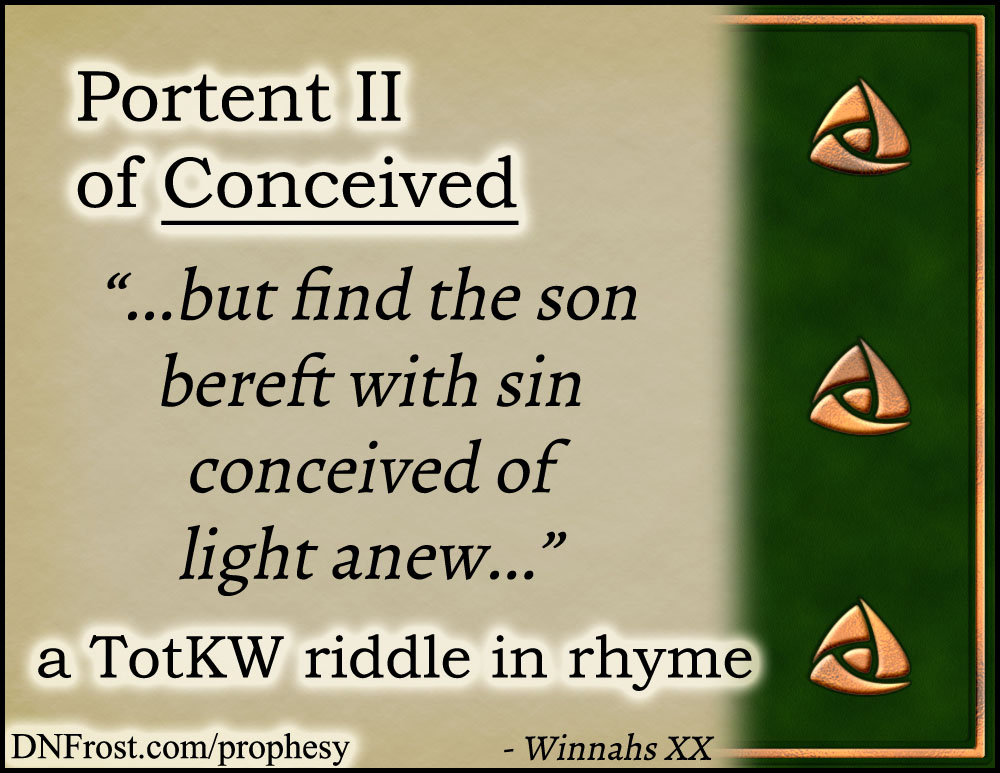
In the novel Conceived, there are many portents fortelling the events of the unfolding saga.

These upcoming riddles in rhyme are gathered in this TotKW prophesy guide for you to explore.

Find the rest of the TotKW saga in my Books Directory.


Also check out the portents from other TotKW books:
Portents of Awakening: prophetic riddles in rhyme from Book 1 www.DNFrost.com/prophesy #TotKW A prophesy directory by D.N.Frost @DNFrost13 Part of a series. Portents of Broken: prophetic riddles in rhyme from Book 2 www.DNFrost.com/prophesy #TotKW A prophesy directory by D.N.Frost @DNFrost13 Part of a series.


Prophesy Appendix

This prophetic guide details the role and cultural impact of prophesy, as well as the inner workings of the prophetic cycle.

Nearly all merfolk men produce a portent every twenty days, and they devote their lives to interpretation.

Read more about this prophetic exclusive here...
Download the Prophesy Appendix:


A Note on the Uncommon Spelling of Prophesy

Throughout the saga, this word is spelled with an /s/ in all cases.

There are three linguistic reasons for choosing this variant spelling.

Read more on this note here...


You are invited to use these riddles to herald new plots in your fan-fiction and role-playing games. Check out the Gamers of the Known World for your invitation to use the Known World for your own games and stories.


Can you decode the future Tales of the Known World?

Share your interpretation!
Comment on any portent with your take on its meaning.


Every prophesy is accompanied by an attribution block. This block contains a byline giving the name of the person who said the prophesy, and a dateline giving the day the prophesy was first said.

Prior to the interpretation of portents, these names and dates are the only means of keeping prophesy organized. The portents listed here are arranged from oldest to newest, even if they have already been interpreted.

Click the thumbnails below to view each portent and comment with your own interpretation.


Tattered Prophesy


A tattered prophesy has been fully interpreted.
These tattered portents come to pass in Book 3.


That's it for prophesy from Book 3! Check out the Portents of Awakening for more.

For the Prophesy Appendix, enter your email above.


Liked this? Share, please!

Monday, July 26, 2021

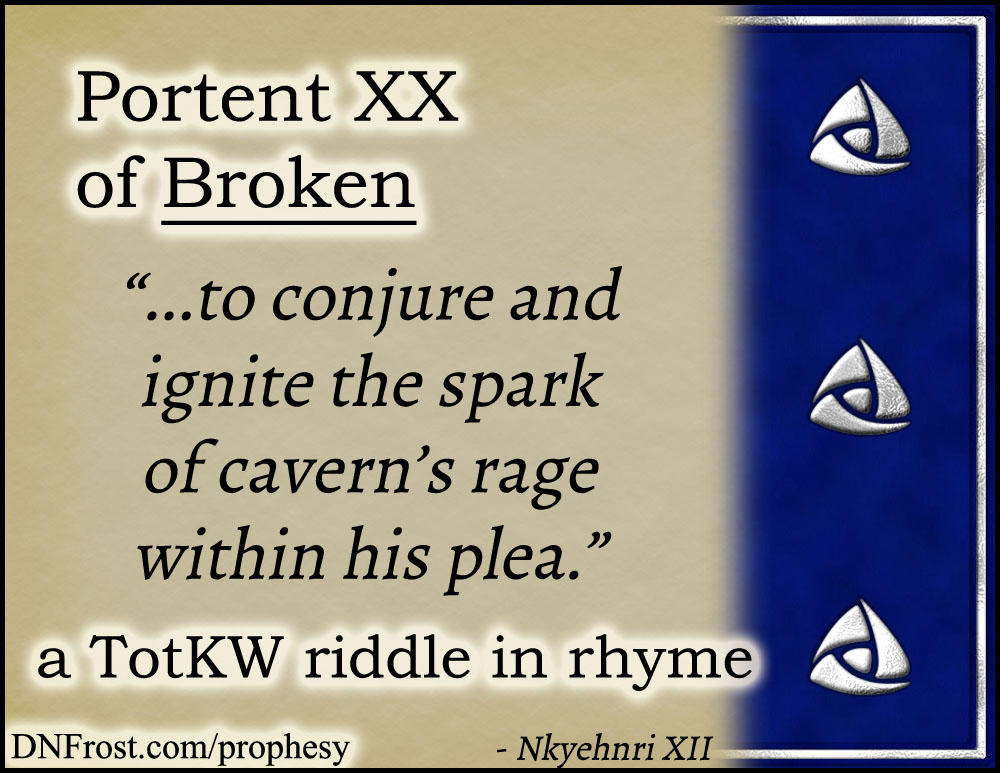
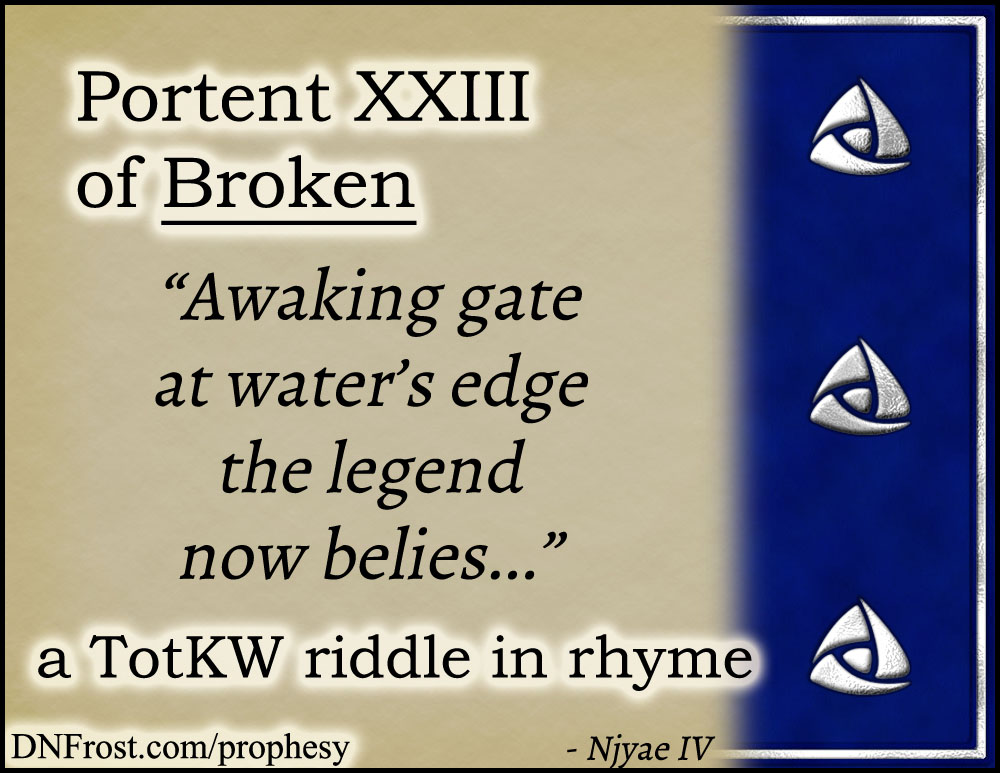
Portents of Broken: a prophesy directory

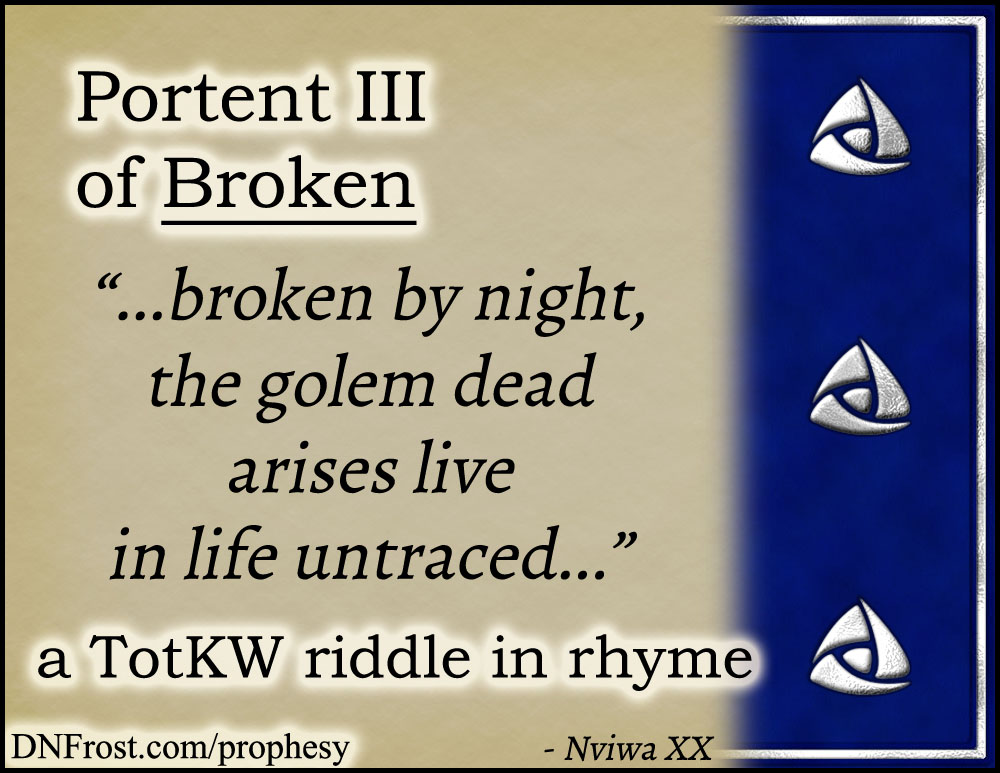
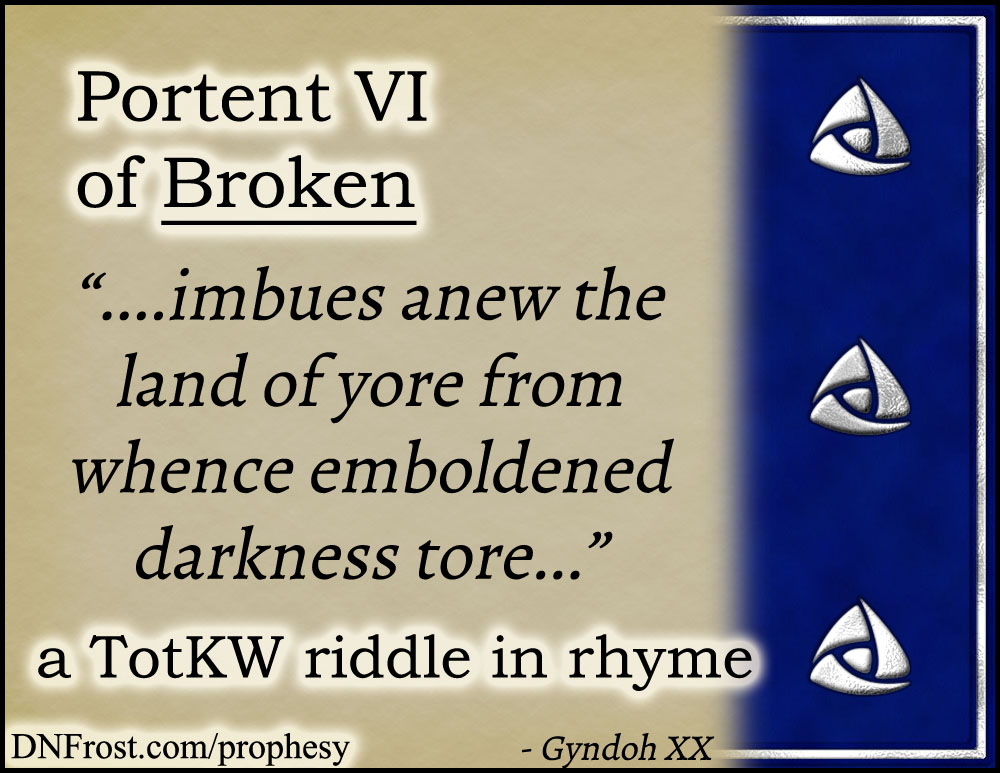
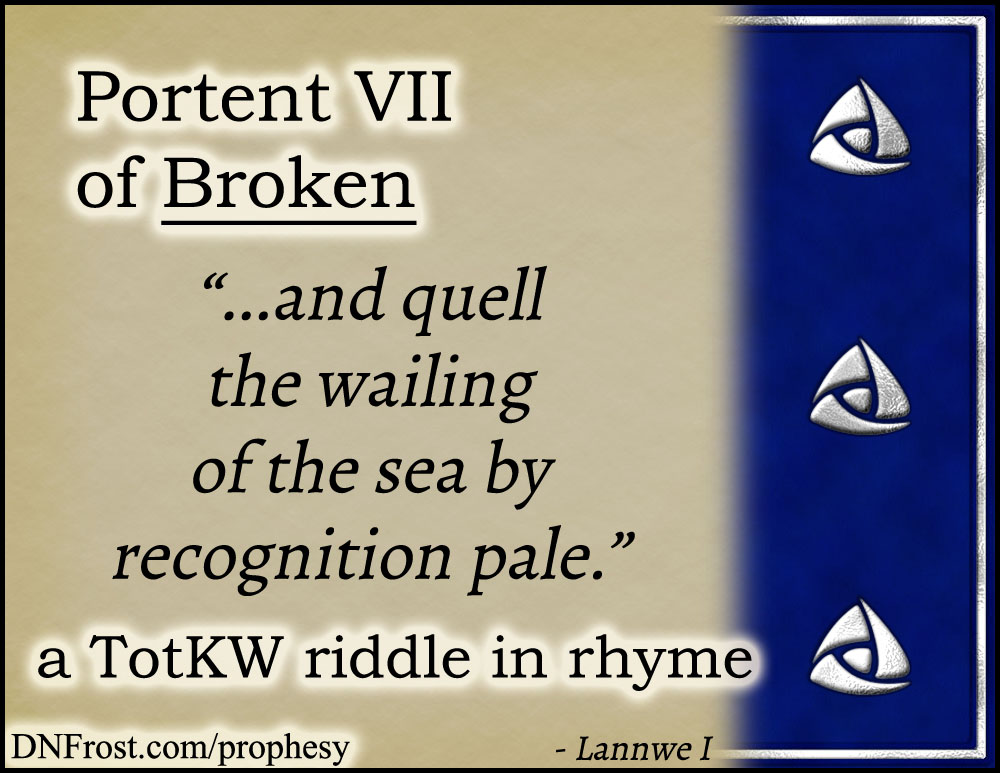
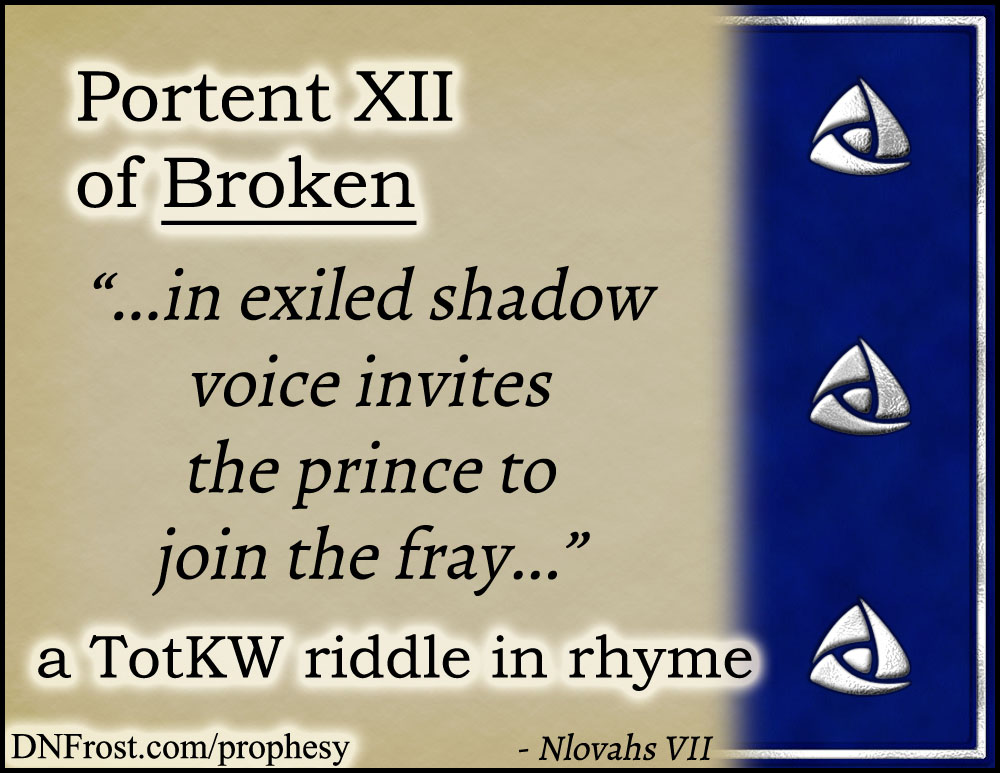
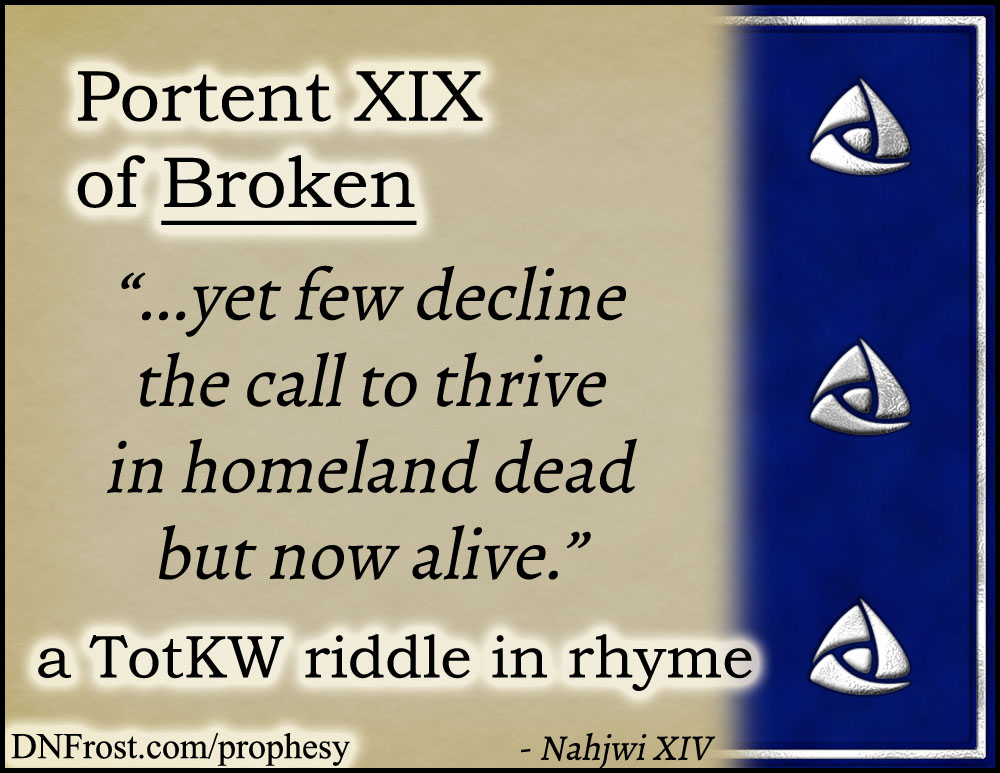
In the novel Broken, there are 24 portents fortelling the events of the unfolding saga.

All of these riddles in rhyme are gathered in this TotKW prophesy guide for you to explore.

Find the rest of the TotKW saga in my Books Directory.


Also check out the portents from other TotKW books:
Portents of Awakening: prophetic riddles in rhyme from Book 1 www.DNFrost.com/prophesy #TotKW A prophesy directory by D.N.Frost @DNFrost13 Part of a series. Portents of Conceived: prophetic riddles in rhyme from Book 3 www.DNFrost.com/prophesy #TotKW A prophesy directory by D.N.Frost @DNFrost13 Part of a series.


Prophesy Appendix

This prophetic guide details the role and cultural impact of prophesy, as well as the inner workings of the prophetic cycle.

Nearly all merfolk men produce a portent every twenty days, and they devote their lives to interpretation.

Read more about this prophetic exclusive here...
Download the Prophesy Appendix:


A Note on the Uncommon Spelling of Prophesy

Throughout the saga, this word is spelled with an /s/ in all cases.

There are three linguistic reasons for choosing this variant spelling.

Read more on this note here...


You are invited to use these riddles to herald new plots in your fan-fiction and role-playing games. Check out the Gamers of the Known World for your invitation to use the Known World for your own games and stories.


Can you decode the future Tales of the Known World?

Share your interpretation!
Comment on any portent with your take on its meaning.


Every prophesy is accompanied by an attribution block. This block contains a byline giving the name of the person who said the prophesy, and a dateline giving the day the prophesy was first said.

Prior to the interpretation of portents, these names and dates are the only means of keeping prophesy organized. The portents listed here are arranged from oldest to newest, even if they have already been interpreted.

Click the thumbnails below to view each portent and comment with your own interpretation.


Tattered Prophesy


A tattered prophesy has been fully interpreted.
These tattered portents come to pass in Book 2.


Download the Prophesy Appendix:


Untattered Prophesy


An untattered prophesy has not yet been interpreted.
These untattered portents are said as Book 2 unfolds.


That's it for prophesy from Book 2! Check out the Portents of Conceived for more.

For the Prophesy Appendix, enter your email above.


Liked this? Share, please!
Hello, there! Connect with me:
TwitterFacebookPinterestInstagram

Leave a comment, ask a question, share a story, make a friend.